A WhatsApp chatbot automates responses by following predefined rules. A conversational AI agent understands message intent, retains context across the full conversation, and resolves complex requests without human intervention. WhatsApp crossed 3 billion monthly active users in May 2025 and carries a 98% message open rate, according to Meta and Infobip 2026. It is the highest-reach customer communication channel available to any business, and the technology operating inside it just changed significantly.
For years, having a chatbot on WhatsApp was enough. Fast responses to frequent questions, option menus, availability outside business hours. It worked. But responding is not the same as resolving, and customers today expect more than predefined options when they message a business. According to HubSpot 2024, 82% of service professionals say customers now expect immediate resolution, and 60% define immediate as ten minutes or less.
This article explains what a WhatsApp chatbot is, how it evolves into an AI agent, what the concrete differences are between both, and what your business should consider before implementing a conversational solution. If you want to understand how AI can transform your customer service and sales, our AI marketing service is built exactly for that.
What is a WhatsApp chatbot and how does it work?
A WhatsApp chatbot is an automated system that responds to messages inside the platform by following programmed rules or flows. When a customer writes, the chatbot identifies keywords or menu selections and returns a predefined response.
There are two main types. A rule-based chatbot follows fixed decision trees: if the customer writes "price," it responds with the price list; if they write "hours," it responds with business hours. It is simple, predictable, and effective for repetitive and well-defined queries. An AI-powered chatbot uses natural language processing to interpret messages without depending on exact keywords. It can handle variations and more open-ended questions, though it remains more limited than a full AI agent.
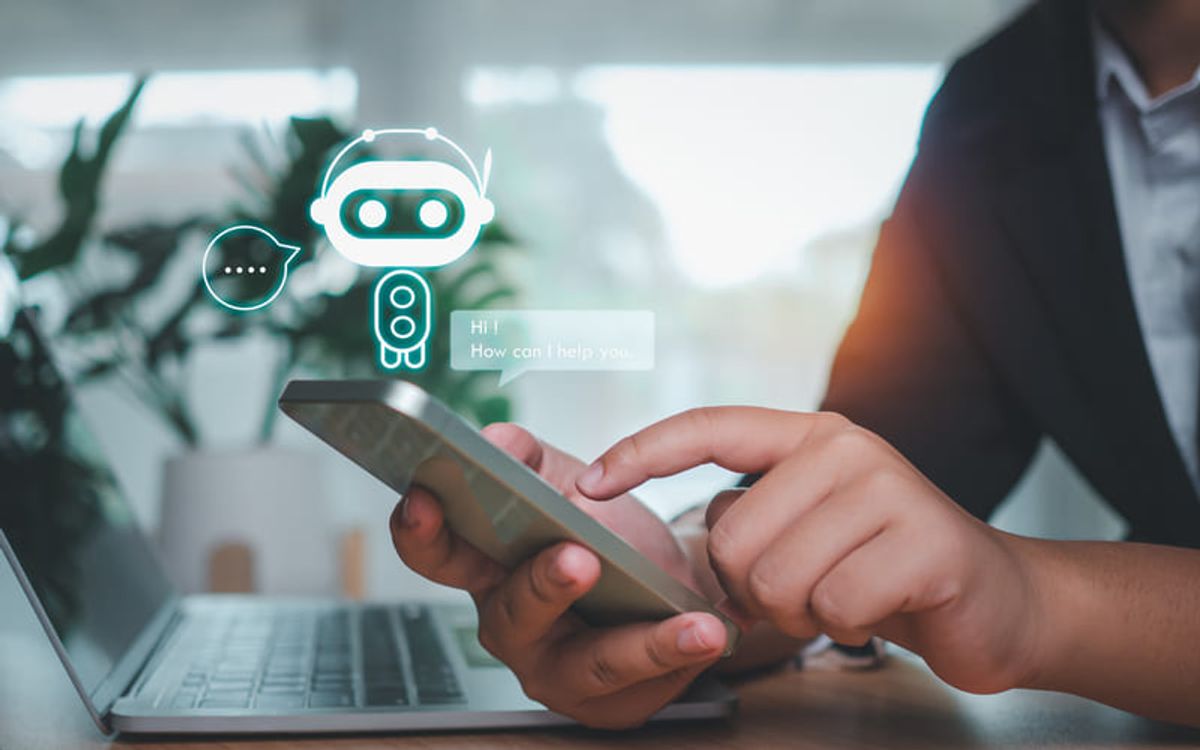
The difference between both is not response speed. It is what kind of conversations they can handle and how far they can go without a human taking over. To understand how a chatbot fits within a broader digital strategy, read: WhatsApp chatbot: complete guide.
What is a conversational AI agent and how is it different?
A conversational AI agent is a system that uses generative artificial intelligence to understand the intent behind each message, remember the full conversation context, make decisions, and execute actions autonomously. It does not follow a script. It reasons about what the customer actually needs and builds a response appropriate to that specific moment.
| Criteria | Traditional chatbot | AI agent |
|---|---|---|
| How it works | Predefined rules and flows | Natural language processing and reasoning |
| Context handling | No conversation memory | Remembers and uses full context |
| Question types | Only programmed ones | Any question in natural language |
| Personalization | Generic responses | Responses adapted to each customer and moment |
| Integration | Limited | CRM, databases, sales systems |
| Scalability | Linear: more questions require more programming | Exponential: more knowledge resolves more cases |
| Cost per interaction | Low but limited | Higher initial investment, higher return |
According to Gartner, 85% of customer service leaders explored or piloted customer-facing conversational generative AI during 2025. The exploration phase is over. 2026 is the year of scaled implementation.
How a conversational AI agent works on WhatsApp Business
For an AI agent to operate on WhatsApp, access to the WhatsApp Business API is required. This is the integration layer that connects WhatsApp with external systems such as AI platforms, CRM tools, and databases. This API is not available in the standard WhatsApp Business version and requires configuration through Meta-certified providers.
The flow of a conversation with a WhatsApp AI agent works as follows: the customer sends a message, the API receives it and passes it to the AI engine, the agent interprets the intent, queries relevant information from connected databases, generates a personalized response, and delivers it to the customer within seconds. If the request exceeds its configured scope or involves a sensitive decision, the agent escalates the conversation to a human agent with the full context preserved.
This integration with CRM and automation systems is what turns an AI agent into something beyond a response assistant. It becomes part of the commercial process. Our CRM and automation service connects these solutions with your actual business processes so every WhatsApp conversation has a measurable impact on your results.
Use cases for AI agents in business
AI agents on WhatsApp are not only customer service tools. They can operate across multiple points of the commercial process:
24/7 customer service
The agent responds to queries outside business hours, resolves complex frequently asked questions, and manages support requests without a human agent needing to be available. According to ChatMaxima 2026, AI-managed interactions cost approximately $0.50 on average, compared to $6.00 per human interaction.
Lead qualification and follow-up
When a potential customer writes on WhatsApp, the agent can ask qualification questions, identify interest level, log the information in the CRM, and assign the opportunity to the right sales team member with the full conversation context already documented.
Scheduling and confirmations
The agent can check calendar availability, schedule appointments, send confirmations and automatic reminders, all within the same WhatsApp conversation without human intervention.
Post-sale support
Order tracking, warranty management, common issue resolution, and agile escalation to a specialist when the situation requires it, with the full interaction history preserved for the human agent.
Cart recovery and reactivation
In ecommerce and service businesses, the agent can identify inactive customers or abandoned carts and reactivate conversations with personalized messages based on each customer's history.
How to know if your business needs a chatbot or an AI agent
The choice between a traditional chatbot and an AI agent depends on several factors worth evaluating before investing:
Choose a rule-based chatbot if: your query volume is low, questions are always the same and predictable, your implementation budget is limited, or you are starting to automate and want a simple entry point.
Choose an AI agent if: you receive a high volume of conversations with varied and not always predictable questions, you need the system to remember context between messages, you want to integrate customer service with your CRM and sales processes, or you want WhatsApp to be a channel that actually converts rather than just responds.

According to McKinsey State of AI 2025, 62% of organizations are already experimenting with AI agents and 23% have scaled them. Companies that move first are building an advantage that compounds over time. To understand how artificial intelligence can improve not just customer service but your entire digital strategy, read: AI in marketing: the tools that actually work. And if you want to evaluate which solution makes sense for your business right now, contact us and we will analyze it together at no cost.
The WhatsApp chatbot evolved, and your customer service strategy can too
WhatsApp is no longer just a messaging channel. With 3 billion users and a 98% message open rate, it is the highest-reach and highest-engagement customer communication channel available to any business. The difference between using it as an automated response channel or as an intelligent conversational system that serves, qualifies, and converts is exactly the difference between a traditional chatbot and an AI agent.
Companies integrating AI agents into their WhatsApp customer service report higher customer satisfaction, lower cost per interaction, and more conversions through the same channel. According to Zendesk's 2025 CX Trendsetters report, companies leading in AI-powered customer experience see 33% higher customer acquisition and 22% higher retention. Those are not technology benefits. They are business outcomes.
At Hiweb we implement conversational AI and automation solutions that connect WhatsApp with your actual commercial processes.Text us on WhatsApp for a no-commitment evaluation, or contact us and we will design the right solution for your business together.
Frequently Asked Questions
A chatbot follows predefined rules and can only respond to what was programmed. An AI agent uses natural language processing to understand message intent, retains conversation context, and can resolve complex requests autonomously.